Choosing an Aluminum Door With Window is not just a matter of appearance. For buyers comparing manufacturers in China, frame design, glazing, weather seals, drainage, and hardware all affect daily performance. Small details matter. A poorly finished corner or loose locking point can become obvious after months of use.
The stakes extend beyond the doorway. The 2023 Global Status Report for Buildings and Construction, published by the United Nations Environment Programme and GlobalABC, estimates that buildings accounted for 34% of global energy demand and 37% of energy- and process-related carbon dioxide emissions in 2022. These figures do not prove that one door saves a set amount of energy. They do explain why thermal breaks, suitable glazing, and careful installation deserve attention.
This guide introduces Chinese manufacturers and the practical questions buyers should ask before requesting a quotation. Look for clear product specifications, documented test methods, consistent finish quality, and responsive after-sales support. Ask how the supplier checks frame joints, water drainage, and hardware operation—not only how the product looks in a showroom. A polished sample is useful, but it cannot tell the whole story. Manufacturer claims should be checked against project requirements and independent documentation where available. Even a well-made door can disappoint if measurements or installation are wrong. That is easy to overlook. The comparisons ahead aim to help readers assess suppliers with care, while recognizing that the best choice depends on climate, building design, budget, and intended use.
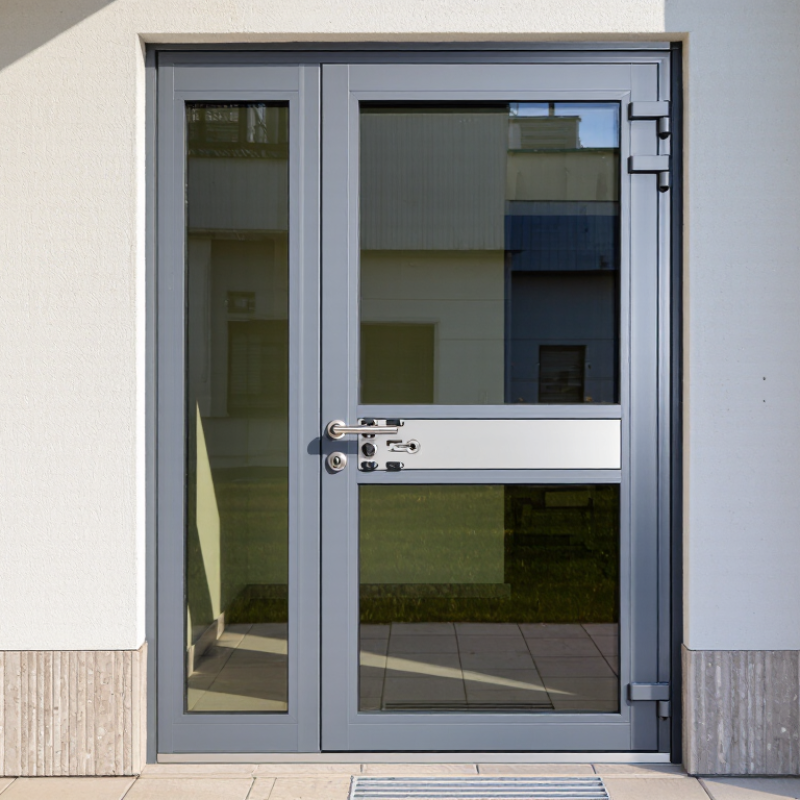
An aluminum door with a window combines a load-bearing aluminum frame, an operable or fixed door leaf, and glazed panels. The glass may sit within the main leaf, beside it as a sidelight, or above it as a transom. That detail matters. The configuration affects daylight, sightlines, privacy, and how much frame is needed to support the glass.
The aluminum profile is more than a thin border. Internal chambers and, in many designs, a thermal break help limit heat transfer. Glazing may be single, laminated, or insulated, depending on climate, noise, security needs, and budget. A sunny entrance may benefit from low-emissivity glass, while a shaded interior partition may not. There is no universal best glass.
A properly specified door also accounts for seals, hinges, locks, drainage paths, and installation clearances. These details affect whether it closes smoothly and resists drafts or rain. Check the glass thickness, frame finish, opening direction, and available test data when comparing products. Small gaps can cause trouble. Still, specifications alone cannot show how accurately a unit was assembled; sample inspection and clear installation drawings are useful.
When evaluating aluminum door manufacturers in China, look beyond polished showrooms. Ask how they control frame dimensions, corner joints, drainage channels, and glass installation. These details affect how a door performs after repeated opening and exposure to rain. Request product drawings, material specifications, and test documents that match the model you plan to order. A report for a different configuration proves little.
Check whether the manufacturer can provide a sample, explain its aluminum profile and glass options, and show how hardware is fitted. Compare the sample with production units before confirming a large order. Ask for written details on packaging, lead times, warranty coverage, and replacement parts. Clear answers matter. Vague promises deserve follow-up. No checklist removes every risk, and a factory visit may not reveal every production issue. Still, dated inspection records and traceable batch information offer useful evidence.
Tips: Send the same questions to each supplier, then compare specific answers rather than sales claims. Photograph sample corners, seals, and hardware for reference. Confirm that quoted performance figures apply to the exact door size and glass build. If a detail remains unclear, pause and ask again.
A capable manufacturer should customize more than frame color. Ask about opening direction, mullion layout, glass thickness, thermal breaks, drainage paths, and hardware options. These details affect how a door feels and performs in daily use. A sliding panel should move smoothly, while a hinged leaf needs stable alignment and secure seals. Small samples help reveal finish and gasket quality.
Energy performance deserves evidence. The IEA’s 2023 Global Status Report for Buildings and Construction estimates that buildings account for about 30% of global final energy use and 26% of energy-related emissions. That does not mean a door alone determines a building’s energy use. It does make glazing, frame insulation, and air leakage sensible questions. Request documented thermal values and applicable air, water, and wind-resistance test results.
A neat catalog is not proof. Check whether the factory can keep tolerances consistent across a full order, not just one display unit. Ask for drawings, glass specifications, finish samples, and inspection records before production. Custom dimensions may require extra tooling or longer lead times. One detail is easy to miss: installation conditions can change real-world performance. Even strong factory testing cannot compensate for poor fitting. Manufacturers should explain the limits clearly, though this is sometimes overlooked.
Notable aluminum door with window manufacturers in China are best judged by what they can document, not by polished showroom photos. Ask how they control alloy thickness, thermal-break placement, corner sealing, and drainage. A sample should show clean mitres, even powder coating, and a sash that closes without rubbing. Small flaws matter. They often reveal process consistency.
Energy performance deserves equal attention. The International Energy Agency’s Global Status Report for Buildings and Construction 2024 estimates that
buildings and construction accounted for 32% of global energy use and 34% of energy-related CO₂ emissions in 2022.
That makes glazing choice, air leakage, and frame design practical questions—not decoration. Request test results for the complete door-and-window assembly, including its specified glass and hardware. A frame-only figure can be misleading.
When comparing Chinese suppliers, review factory inspection records, production lead times, packaging details, and after-sales procedures. Confirm whether custom dimensions affect testing or warranty coverage. Ask for photos of finished units before shipment, especially at hinges, locks, and sill corners. Some suppliers may offer many profiles but limited project-specific testing; that is worth probing. No checklist replaces a site visit, and I would treat unusually broad performance claims cautiously.
Choosing an aluminum door with window manufacturer starts with the project details, not a catalog photo. Share the opening size, wall type, installation location, and expected daily use. A coastal entrance may need a different finish and drainage design than an interior partition. Small details matter. Ask how the frame handles water, air, and thermal transfer, and request drawings showing glass thickness, frame depth, and hardware positions.
Then check how the manufacturer controls production. Ask for a sample corner, finish chip, or completed unit before approving a large order. Look for consistent welds, smooth edges, and glass seated evenly in its frame. Request relevant test reports and confirm what their results cover; a report for one configuration may not apply to another. Discuss packaging, lead times, replacement parts, and how defects are documented. Clear answers are useful. Vague promises are not. Compare quotations line by line, including hardware, glazing, and delivery terms. If measurements or drawings remain uncertain, pause and resolve them. I would still leave room for revision: projects change, and a supplier’s willingness to flag a mismatch early can matter as much as a low price.
Specify opening direction, mullion layout, glass thickness, thermal breaks, drainage, and hardware. Small details matter.
Ask for documented thermal values and applicable air, water, and wind-resistance test results. Check which door configuration each report covers.
Request a sample corner, finish chip, or completed unit. Inspect welds, edges, gaskets, and how evenly the glass sits.
No. Poor fitting can reduce real-world performance, even when factory testing looks strong. Installation conditions matter.
Share opening dimensions, wall type, location, and expected daily use. A coastal entrance may need different drainage and finishes.
Compare glazing, hardware, packaging, delivery terms, and lead times line by line. A low price can leave details unclear.
Yes. Custom sizes may require extra tooling or longer lead times. Ask before approving production.
Pause and resolve measurements or design mismatches before production. I might still miss something, so a revision check helps.
This guide explains what makes an Aluminum Door With Window a practical choice, from its frame and glazing options to its balance of light, privacy, durability, and appearance. It outlines how to assess manufacturers in China by considering their production experience, quality-control processes, communication, project support, and ability to provide clear product specifications. Readers will also learn which manufacturing and customization capabilities matter, including options for dimensions, finishes, glass configurations, hardware, and opening styles.
Rather than focusing on brand names, the guide describes how to compare potential manufacturers and identify suppliers whose capabilities match a project’s requirements. It offers a straightforward approach to evaluating product samples, confirming customization details, reviewing lead times, and discussing after-sales support. By weighing these factors together, buyers can make a more informed choice and select a manufacturer suited to their design, performance, and budget priorities.