0%

Choosing the right Aluminum Bathroom Door is more practical than simply selecting an attractive finish. Daily steam, splashing water, cleaning chemicals, and limited ventilation can expose weak materials quickly. A door may look perfect in a showroom, yet fail beside a constantly wet shower area.

Joseph Lstiburek, a respected building-science expert, often emphasizes moisture control: “If you don't know where the water is going, you don't know anything.” His warning applies directly to bathroom doors. Water paths matter. So do drainage, sealing, and airflow.

This guide examines frame alloy, surface treatment, glass compatibility, hinge strength, and installation quality. Aluminum frames made from 6063-T5 alloy can offer useful strength and corrosion resistance. Anodized finishes usually provide a clean, durable surface. Powder coating adds color choices, but scratches may require careful repair.

Small details become important. Check the bottom sweep. Inspect the corners. Test the latch with wet hands. A poorly aligned door can scrape the threshold every morning. That annoyance becomes expensive when moisture enters the wall.

There is no universal best choice. A compact bathroom may need a sliding door, while a larger room may suit an outward-opening design. Local safety requirements and accessibility needs also deserve attention. I would not choose a door based on price alone. That approach is tempting, but incomplete.

The following sections explain how to compare Aluminum Bathroom Door options with clearer judgment. They also consider maintenance, appearance, privacy, and long-term value. Some recommendations may need adjustment after inspecting your actual bathroom. That is normal. Good decisions begin with honest measurements, realistic use, and careful attention to water.
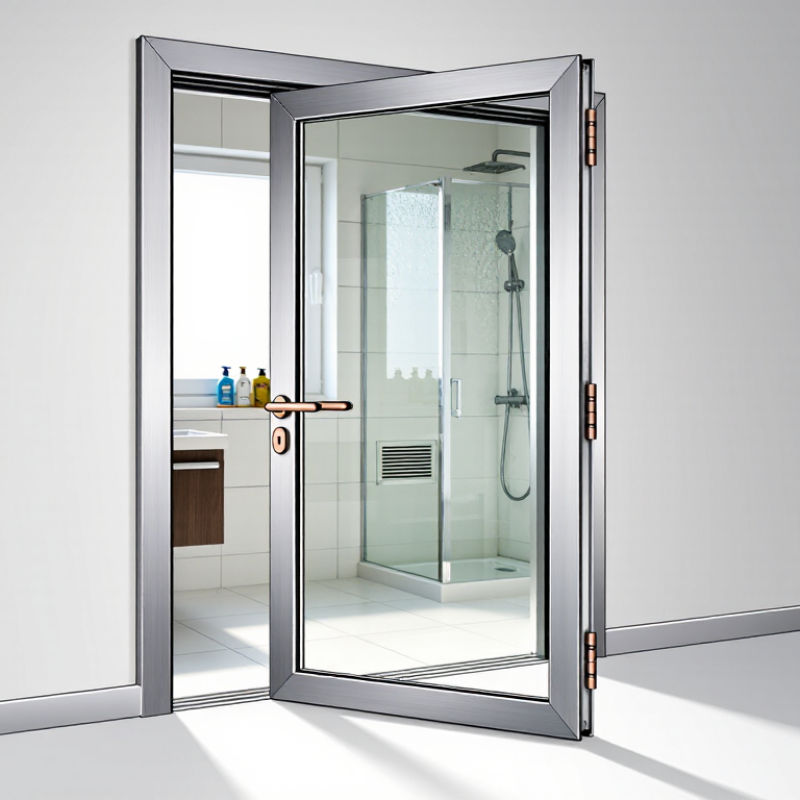
How to Choose the Best Aluminum Bathroom Door?

Define Your Bathroom Door Requirements and Space Constraints

Before choosing an aluminum bathroom door, measure the real opening, not the old door panel. Record width, height, wall thickness, swing direction, and nearby fixtures. Leave enough clearance for knees, towels, and safe movement around the toilet. The 2010 ADA Standards recommend a 32-inch minimum clear opening where accessibility rules apply, although local requirements may differ. Treat that figure as a reference, not a universal answer.

Space changes the door type. A sliding aluminum door can protect a narrow walkway, while an outward-swinging door may improve emergency access. Hinged doors need a clear arc, especially beside a vanity or shower screen. The 2024 NKBA Bathroom Design Trends Report identifies accessibility and larger shower areas as continuing design priorities. That supports planning for wider movement zones, even in compact bathrooms. Small rooms punish careless measurements.

Check moisture exposure before selecting the frame. Ask for corrosion-resistant aluminum, reliable seals, and hardware suited to frequent humidity. The U.S. Green Building Council notes that durable materials can reduce replacement demand over a building’s life. Still, aluminum is not maintenance-free. Poor drainage, trapped soap, or loose fasteners can shorten performance. Measure twice. Recheck after tiling. A few millimeters can change the installation.

Compare Aluminum Grades, Finishes, and Corrosion Resistance

Choosing an aluminum bathroom door starts with the alloy, not the color. For extruded frames, 6063-T5 is widely used because it forms clean profiles and accepts anodizing well. For heavier loads, 6061-T6 offers greater strength, but machining may leave a less uniform appearance. If the door uses sheet panels, 5052 deserves consideration because its magnesium content supports good resistance in humid conditions. Alloy choice is a trade-off.

Bathrooms create a small but aggressive test chamber: warm air, condensation, cleaners, and trapped water around hinges. The NACE IMPACT study estimated that corrosion costs about US$2.5 trillion annually, equal to 3.4% of global GDP. That figure covers all industries, not bathrooms, but it explains why drainage and coating quality matter.

Look beneath the finish. Anodizing creates a hard oxide layer and preserves a metallic appearance. Powder coating offers more colors, but damaged edges can expose aluminum to moisture. A thicker coating is not automatically better.

Ask for test evidence, not vague claims. AAMA 611 addresses anodized coatings, while AAMA 2604 and 2605 define performance expectations for architectural coatings.

Inspect cut edges, screw points, hinge pockets, and the lower rail. These areas often fail first.

In practice, water should drain freely, fasteners should be corrosion-compatible, and cleaner instructions should be specific. I would not trust a polished sample alone. Real durability is often hidden underneath.

Evaluate Door Styles, Glass Options, and Ventilation Features

When choosing an aluminum bathroom door, start with the room’s daily behavior, not appearance alone. A sliding door saves floor space, while a hinged door usually offers a tighter, simpler seal. For a narrow bathroom, sliding panels can prevent collisions with the toilet or vanity. Measure twice. Leave enough clearance for cleaning and hardware adjustment. An experienced installer should also check wall alignment, because uneven surfaces can make a good door feel poorly made.

Glass changes privacy, light, and maintenance. Clear glass visually enlarges a dim room, but it exposes water spots and personal activity. Frosted or patterned glass offers privacy without making the space feel closed. Tempered safety glass suits bathrooms because it is designed to break into smaller, less sharp pieces. Still, textured glass is not automatically easy to clean. Often overlooked. Ask how soap residue will be removed from its surface and aluminum edges.

Ventilation deserves equal attention. Bathrooms need moisture to escape, especially after hot showers. Choose a door with a modest bottom gap, louvered section, or compatible transom while preserving privacy. Pair it with an effective exhaust fan and keep airflow paths clear. I have seen attractive doors fail because steam stayed trapped around the aluminum frame. However, larger openings may admit noise, odors, or cooler drafts. Balance airflow against comfort. Review hinge quality, drainage paths, and corrosion-resistant finishes before ordering. Specifications matter more than showroom shine.

Check Measurements, Hardware Quality, Safety, and Installation Needs

How to Choose the Best Aluminum Bathroom Door?

Begin with precise measurements, not estimates. Measure the width at the top, middle, and bottom of the opening. Record the smallest measurement. Uneven walls can create surprising gaps. Check the height, wall thickness, floor level, and door swing direction. Leave enough clearance for towels, cabinets, and safe movement. A few millimeters matter.

Hardware quality affects daily comfort and long-term reliability. Choose corrosion-resistant hinges, handles, screws, and rollers for humid bathrooms. Open and close the sample door several times. It should move smoothly without scraping or rattling. Inspect the seals closely. Flexible seals help reduce water leakage, but they cannot correct poor alignment. I once saw a well-made door fail because the frame was installed slightly out of square.

Safety needs practical attention. Select tempered safety glass when glass panels are included, and avoid sharp exposed edges. The door should not block the main exit or strike nearby fixtures. Check whether children or older users need a lighter operation force. Small details help.

Installation requirements are easy to underestimate. Confirm the wall material before ordering, especially when fixing into tile, drywall, or masonry. Some surfaces need suitable anchors and careful drilling. A qualified installer can check plumb, level, drainage, and sealant placement. Follow the manufacturer’s instructions and local building requirements. Do not rush the final adjustment. A small installation error may cause leaks, noise, or premature wear. My own checklist would include one extra site visit, although that is not always convenient.

How to Choose the Best Aluminum Bathroom Door? - Check Measurements, Hardware Quality, Safety, and Installation Needs

Practical selection checklist for an aluminum bathroom door
Evaluation Dimension Recommended Benchmark Typical Data or Measurement How to Check Before Purchase Potential Problem if Ignored Priority
Finished Opening Width Measure the actual finished wall opening, not the nominal door size. Record width at the top, middle, and bottom. Use the smallest reading when the opening is uneven. Measure after tiles, waterproofing, and wall finishes are complete. Confirm the frame adjustment range with the installer. The door may not fit, close correctly, or leave an uneven gap. High
Finished Opening Height Take measurements from the finished floor or sill to the top of the opening. Measure at the left, center, and right sides. Check floor slope and the height of any threshold. Do not measure from an unfinished floor if additional tile, mortar, or trim will be installed. The door can rub against the floor or leave an excessive gap underneath. High
Door Swing and Clearance The leaf must open without hitting a toilet, vanity, wall, towel rail, or shower fitting. Allow the full door-leaf arc plus handle clearance; sliding doors need clear side-wall space. Mark the swing path on the floor or use the manufacturer’s installation drawing before ordering. Restricted access, damaged fixtures, or a door that cannot fully open. High
Frame Material Use corrosion-resistant aluminum suitable for humid indoor environments. Common aluminum frame alloys include 6063, which is widely used for extruded architectural profiles. Ask for the alloy or material specification and inspect the surface for consistent coating and straightness. Corrosion, discoloration, deformation, or premature finish failure. High
Surface Finish Choose a uniform anodized or powder-coated finish designed for bathroom humidity. Anodized aluminum forms a protective oxide layer; powder coating provides a separate protective finish. Inspect edges, corners, drilled areas, and contact points for scratches, exposed metal, or poor coverage. Staining, peeling, scratching, and difficult cleaning. Medium
Glass Safety, If Glazed Use safety glazing; tempered glass is commonly used for bathroom doors. Typical tempered bathroom-door glass is often 6–8 mm thick, depending on the door design and panel size. Request safety-glazing documentation and verify that the glass thickness matches the approved design. Greater injury risk if ordinary glass breaks. High
Hinges and Load Capacity Hinges must be rated for the complete door weight, including the glass and hardware. Use the hinge manufacturer’s stated load rating and required number of hinges; do not estimate by appearance alone. Confirm the door weight, hinge rating, fixing method, and adjustment range in the installation documents. Sagging, misalignment, noisy operation, or hinge failure. High
Handle and Fasteners Select corrosion-resistant handles, screws, and brackets suitable for wet areas. Stainless steel is commonly selected for bathroom hardware; grade and finish should be specified for the application. Check threads, welds, edges, mounting washers, and compatibility between fasteners and the aluminum frame. Rust marks, loose hardware, sharp edges, and difficult maintenance. Medium
Seals and Water Control Use continuous, replaceable seals or sweeps at the door edges and bottom where required. Seal selection depends on the door gap, threshold, swing direction, and bathroom layout. Ensure seals are flexible, firmly seated, and not compressed unevenly. Confirm that water drains toward the wet area. Water leakage, damp flooring, mold growth, and damaged finishes. High
Threshold and Floor Condition The floor must be level enough for the selected door system and have adequate waterproofing. Check the floor slope, tile level, drain position, and threshold height before installation. Use a spirit level and verify that the door will not scrape the highest point of the finished floor. Poor drainage, standing water, door friction, or damaged tiles. High
Wall Substrate and Fixing Fixings must be anchored into a sound substrate appropriate for the wall construction. Tile alone is not a structural fixing point; the installer may need masonry anchors or suitable wall plugs. Identify studs, masonry, pipes, and electrical cables before drilling. Loose frames, cracked tiles, hidden-service damage, or unsafe installation. High
Ventilation and Moisture Control The bathroom should have effective exhaust ventilation or adequate natural airflow. Ventilation helps reduce condensation and moisture exposure on the door, frame, walls, and hardware. Confirm that the exhaust fan vents outdoors where required and that air can enter the bathroom safely. Condensation, mildew, odor, and accelerated hardware deterioration. Medium
Maintenance Access Choose components that can be cleaned, adjusted, and replaced without removing the whole door. Replaceable seals, accessible screws, and adjustable hinges simplify long-term maintenance. Ask how to clean the frame, lubricate moving parts, adjust alignment, and replace seals. Higher maintenance cost and early replacement of otherwise usable parts. Normal
Installation Responsibility Use a qualified installer when glass panels, waterproofing, or structural fixing are involved. Installation should follow the door system’s approved drawings, clearances, and fixing instructions. Clarify who handles site measurement, delivery inspection, drilling, sealing, adjustment, and final testing. Voided warranty, water leakage, unsafe operation, or costly rework. High

Note: Exact dimensions, glass thickness, hardware ratings, clearances, and fixing methods must be confirmed against the selected door system, site conditions, local building requirements, and installation instructions.

Balance Long-Term Durability, Maintenance, and Overall Cost

How to Choose the Best Aluminum Bathroom Door?

Balance Long-Term Durability, Maintenance, and Overall Cost

A good aluminum bathroom door should handle moisture, frequent cleaning, and daily movement without becoming difficult to operate. Look for corrosion-resistant aluminum with a durable anodized or powder-coated finish. These surfaces can reduce staining and surface wear, but they are not maintenance-free. Check the door frame, corners, and lower edge carefully. Water often collects there.

Hardware deserves equal attention. Stainless steel hinges, reliable rollers, and replaceable seals usually support a longer service life. A tight seal helps prevent splashes, yet excessive pressure can make the door drag. Proper installation matters greatly. The wall must be plumb, and drainage should keep water away from the frame. A low purchase price may seem attractive. It can become expensive when hinges, seals, or panels need early replacement. I would compare total ownership cost over five to ten years, not only the invoice.

Tips: Choose a finish suited to humid rooms. Ask about spare seals and hardware. Test the door before accepting installation. Listen for scraping. Inspect the bottom edge after several weeks. Small defects are easier to correct early. Also, avoid choosing purely by appearance. A bright finish may show water marks more clearly, and a heavier door may require stronger fittings. There is no perfect option; the practical choice depends on ventilation, cleaning habits, and installation quality.

FAQS

Which aluminum bathroom door style suits a narrow room?

A sliding door saves floor space and reduces collisions with toilets or vanities. A hinged door usually provides a simpler, tighter seal. Measure the opening and swing area carefully.

How should I measure the bathroom doorway?

Measure width at the top, middle, and bottom. Record the smallest measurement. Check height, wall thickness, floor level, and door clearance. A few millimeters matter.

Which glass type offers better bathroom privacy?

Clear glass adds visual space but shows water spots and activity. Frosted or patterned glass provides privacy while preserving light. Textured glass still needs careful cleaning.

Is tempered glass suitable for bathroom doors?

Tempered safety glass is a practical choice for glass panels. It is designed to break into smaller, less sharp pieces. Avoid doors with exposed sharp edges.

How much ventilation should a bathroom door provide?

A modest bottom gap, louvered section, or compatible transom can release moisture. Pair it with an effective exhaust fan. Larger openings may admit noise, odors, or cold drafts.

What hardware quality should I check before ordering?

Look for corrosion-resistant hinges, handles, screws, and rollers. Open the sample door several times. It should move smoothly without scraping or rattling. Listen closely.

What installation problems can affect door performance?

Uneven walls can create gaps and poor alignment. Installers should check plumb, level, drainage, anchors, and sealant placement. A small error may cause leaks or early wear.

How can I compare the long-term cost of bathroom doors?

Compare maintenance and replacement costs over five to ten years. Check whether seals and hardware are replaceable. A low invoice can become expensive later.

What maintenance details are easy to overlook?

Inspect the frame corners, lower edge, seals, and aluminum drainage paths. Remove soap residue regularly. Check the bottom edge after several weeks. Small defects are easier to correct early.

Should appearance determine the final choice?

Not alone. A bright finish may show water marks, while a heavy door needs stronger fittings. I might choose differently after seeing the room’s airflow and cleaning habits.

Conclusion

Choosing the best Aluminum Bathroom Door starts with understanding your bathroom’s layout, available space, moisture levels, and daily usage. Take accurate measurements before selecting a door style, and consider whether a hinged, sliding, folding, or bi-fold design will provide the most practical access. Compare aluminum grades, surface finishes, and corrosion resistance to ensure the door can withstand constant humidity. Powder-coated or anodized surfaces may offer added protection and easier cleaning, while the overall finish should complement your bathroom design.

Next, evaluate glass options, privacy levels, ventilation features, and safety requirements. Frosted, textured, or clear glass can create different visual effects, while tempered safety glass is a sensible choice for wet areas. Check the quality of hinges, handles, seals, tracks, and other hardware, and confirm that installation requirements match your walls and floor conditions. Finally, balance the initial price with expected durability, maintenance needs, energy efficiency, and replacement costs. A well-selected Aluminum Bathroom Door should provide reliable performance, easy upkeep, safe operation, and long-term value.

Ethan

Ethan

Ethan is a professional marketing specialist with a strong understanding of the company’s products, customers, and market dynamics. With a practical approach to communication and a passion for continuous learning, he regularly contributes insightful articles to the company’s blog, helping readers......