China Best Aluminum Wood Door Suppliers & Exporters
The 2025 Architectural Engineering Whitepaper: Technical Specifications, Structural Physics, Thermal Break Innovations, and Supply Chain Benchmarks
Executive Sourcing Digest: Modern high-performance architecture demands a synthesis of natural structural aesthetics and industrial durability. Aluminum-wood doors and window systems represent the pinnacle of this convergence—combining exterior weatherization resilience with interior organic thermal performance. As global building codes transition toward net-zero operational carbon, selecting a qualified Chinese manufacturer requires analyzing timber kiln-drying mechanics, profile extrusion metallurgy, poly-amide thermal breaks, and fenestration structural calculation reports.
Featured Architectural Fenestration Systems
Explore our flagship engineering-grade exterior and interior doors. Engineered for hurricane wind pressure, UV resistance, acoustic isolation, and thermal efficiency.
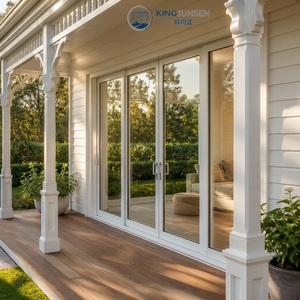
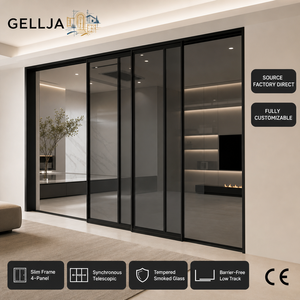
AS2047 Pearl White Aluminum Modern Double Glazed Sliding Door UV Resistant Custom Size for Heritage Villa Exterior Renovation
Engineering Anatomy: Aluminum-Clad Wood vs. Wood-Clad Aluminum
In international fenestration procurement, precise technical nomenclature is critical for avoiding structural specification mismatches. China's top tier suppliers manufacture two primary variations of composite timber-metallic systems: Aluminum-Clad Wood (铝包木) and Wood-Clad Aluminum (木包铝). Understanding their load-bearing physics and thermal performance characteristics dictates project viability.
1. Aluminum-Clad Wood Systems
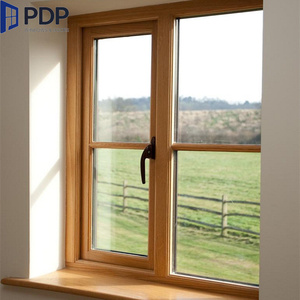
In an Aluminum-Clad Wood configuration, the primary structural load-bearing member is solid timber (e.g., Larch, Oak, or Pine). The exterior face is enveloped by an independent aluminum alloy sash connected via polymer snap-in clips.
Cladding Mechanics: Nylon floating clips absorb differential thermal expansion coefficients between wood ($4 \times 10^{-6}/\text{K}$) and aluminum ($23 \times 10^{-6}/\text{K}$).
2. Wood-Clad Aluminum Systems
Wood-Clad Aluminum reverses the mechanical dynamic: a heavy-duty extruded thermal break aluminum profile serves as the structural backbone, while solid wood veneers or solid wood profiles are mechanically fastened to the interior interface.
Best Applications: High-rise curtain walls, large spans, commercial entryways requiring maximum structural deflection resistance.
3. Timber Processing & Moisture Control
The major cause of door deformation in timber fenestration is moisture migration. Enterprise suppliers employ automated vacuum drying kilns, stabilizing raw timber to an equilibrium moisture content (EMC) of 8% to 12%.
Lamination: 3-layer or 4-layer radial-cut timber laminated with German Henkel D4 polyurethane adhesives.
Coating Systems: Water-borne eco-friendly Sikkens or Remmers coatings, offering micro-porous breathability and 10+ year UV protection.
To assist architectural specifiers and procurement heads in technical evaluation, the matrix below outlines standardized performance metrics according to ISO, EN, and ASTM standards.
Performance Parameter
Aluminum-Clad Wood Door
Thermal Break Aluminum Door
Standard Solid Timber Door
Testing Standard
Thermal Transmittance ($U_w$)
0.8 – 1.2 W/m²K (Passivhaus Ready)
1.4 – 1.8 W/m²K
1.3 – 1.6 W/m²K
EN ISO 10077-2 / NFRC 100
Acoustic Isolation ($R_w$)
38 dB – 45 dB (Triple Glazed)
32 dB – 38 dB
30 dB – 35 dB
ISO 717-1 / ASTM E413
Air Infiltration Rating
Class 4 (Highest Level)
Class 4
Class 2 – 3
EN 12207 / ASTM E283
Water Tightness Pressure
900 Pa – 1200 Pa (Class E900)
750 Pa – 1000 Pa
450 Pa – 600 Pa
EN 12208 / ASTM E331
Wind Load Resistance
Class C5 (5000 Pa / Typhoon Proof)
Class C5 (5000 Pa)
Class C3 (3000 Pa)
EN 12210 / ASTM E330
Service Life Expectancy
50+ Years (Outer PVDF Coating)
40+ Years
15 – 20 Years (Requires Painting)
ISO 15686 Standard
Global Procurement Trends (2025–2030)
The commercial and luxury residential fenestration landscape is undergoing rapid technological shifts driven by carbon taxation, building envelope energy codes, and smart home automation. Leading Chinese manufacturers like Doorreme Aluminum Industry Co., Ltd. are driving these developments through focused R&D investments.
1. Ultra-Narrow Sightlines & Hidden Frames
Architectural trends strongly favor maximal daylight permeability. Modern aluminum-wood sliding patio doors feature concealed structural outer frames embedded within the wall substrate, leaving visible sash sightlines as narrow as 18mm to 25mm. This minimalist profile geometry is engineered without sacrificing structural moment of inertia ($I_x$ and $I_y$ values).
2. Vacuum Insulated Glass (VIG) Integration
While triple-pane double-Low-E argon-filled IGUs remain the standard for low-energy buildings, Next-Gen aluminum-wood doors are integrating Vacuum Insulated Glass (VIG). Achieving thermal resistance values equivalent to solid brick walls ($U_g \le 0.4 \text{ W/m}^2\text{K}$) at a total glass thickness of only 8.3mm, VIG dramatically reduces dead-weight strain on door hardware.
3. Mechatronic Smart Lock Integration
Procurement specifications are pivoting toward factory-installed, fully integrated mechatronics. Concealed multi-point motorized locking gear, biometric fingerprint sensors embedded into stainless steel pull handles, and automated glass tinting via Electrochromic (EC) technology are moving from high-end custom builds to standard OEM export options.
4. Sustainable Sourcing & EPD Transparency
North American and European real estate developers are mandating FSC (Forest Stewardship Council) timber certification and EPD (Environmental Product Declarations) for aluminum extrusions. Low-carbon recycled aluminum billets (smelted via hydro-electric energy) cut embodied carbon footprint by up to 70% during manufacturing.
Manufacturing Excellence: Why Foshan, China leads Global Supply Chains
Located in Shishan Town, Nanhai District, Foshan City—the world's largest aluminum manufacturing cluster—Doorreme Aluminum Industry Co., Ltd. exemplifies enterprise-level export capabilities. Established in 2004, Doorreme operates a state-of-the-art 123,000 square meter production facility staffed by over 800 skilled specialists and engineers.
The Doorreme Industrial Edge
Advanced CNC Machining Centers: Fully automated 5-axis German ELUMATEC and Italian Emmegi machining centers ensure profile cutting and milling precision down to $\pm 0.1 \text{ mm}$.
Surface Treatment Technologies: In-house AkzoNobel fluorocarbon (PVDF) powder coating lines, offering 30-year resistance against coastal salt spray, atmospheric pollution, and intense UV degradation.
Q1: How do Chinese suppliers prevent timber warping in extreme humid or dry destination climates?
Premature timber warping is prevented through rigorous 3-step wood preparation: (1) Computerized kiln drying to precisely match the destination zone's Equilibrium Moisture Content (e.g., 8-10% for North America, 10-12% for Southeast Asia); (2) 3-ply or 4-ply radial-cut finger-jointed lamination which cancels internal wood grain stresses; and (3) Total immersion in anti-fungal micro-porous wood sealers prior to final lacquering.
Q2: What hardware brands are specified for heavy aluminum-wood doors?
Because solid wood and multi-pane tempered glass sashes carry significant dead load (up to 300-400 kg per panel), premier hardware is non-negotiable. Standard specifications include original German Roto NT / Frank Siegenia hardware systems, HOPPE handle sets, and heavy-duty 3D adjustable concealed stainless steel hinges rated for 200,000 open-close cycles.
Q3: Can Chinese suppliers meet local building codes like AS2047, NFRC, or CE marking?
Yes. Tier-1 exporters like Doorreme build units strictly tailored to destination building codes. Products destined for Australia comply with AS2047 and AS1288 glass standards; North American orders meet NFRC thermal standards and AAMA structural testing; European orders are delivered with full CE marking and EN 14351-1 declarations of performance.
Q4: What is the typical lead time for custom project customization?
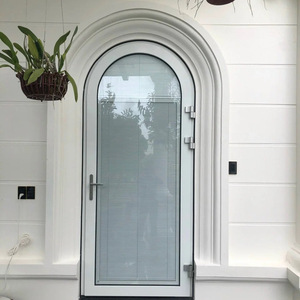
After shop drawings are officially signed off: standard production lead time is 25 to 35 calendar days. Complex architectural finishes (such as custom PVDF colors, rare wood species like Teak or Black Walnut, or curved arch shapes) require approximately 40 days. Emergency fast-track scheduling is available for key commercial projects.
Q5: How are shop drawings managed for overseas structural integration?
Upon receiving CAD layout files, BIM models, or architectural site openings, Doorreme's in-house engineering team provides complete 2D/3D shop drawings detailing anchor bracket locations, flashing details, thermal brake position, perimeter seal interfaces, and glass glassing schedules. Production only commences after customer sign-off.
Request Full Engineering Catalog & Factory Direct Quotes
Partner with China's leading aluminum-wood fenestration manufacturer. Contact our engineering department for shop drawing reviews, physical samples, and comprehensive project pricing.
 English