Explore our export-certified architectural systems designed for thermal efficiency, high wind-load resistance, and long-term durability across North America, Europe, Australia, and the Middle East.
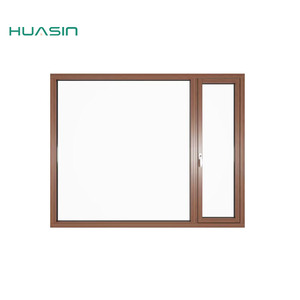
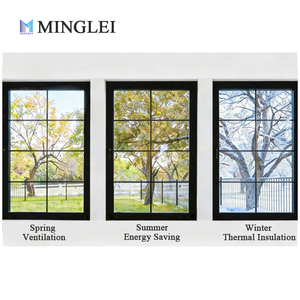
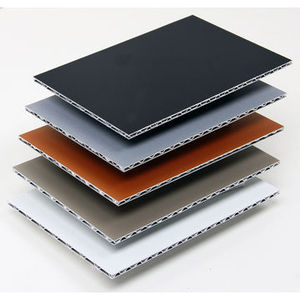
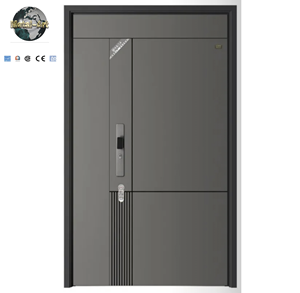
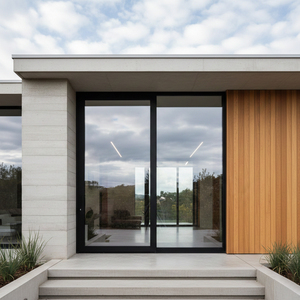
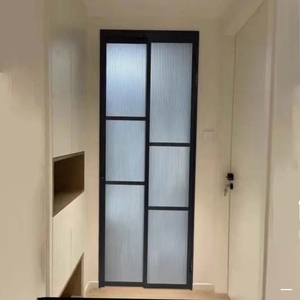
Located in Foshan—the epicenter of global aluminum extrusion—our manufacturing ecosystem integrates vertical raw material sourcing, automated CNC profile fabrication, and advanced glass processing.
From 6063-T5/T6 billet extrusion and anodizing to multi-chamber thermal break assembly and IG unit sealing, every fabrication step occurs under ISO 9001:2015 certified quality controls.
Equipped with Elumatec 5-axis profile machining centers and Bystronic automated insulating glass lines, ensuring profile cutting tolerances within ±0.2mm and double-seal gas retention over 95%.
Our in-house facade engineers calculate site-specific wind loads (ASTM E330), thermal expansion coefficients, and water penetration thresholds (ASTM E331), delivering signed shop drawings for fast local authority approvals.
A structural and thermal performance analysis for architects, commercial buyers, and fenestration importers.
Unreinforced aluminum possesses a high thermal conductivity ($k \approx 200 \text{ W/m}\cdot\text{K}$), making solid aluminum frames prone to massive heat loss in winter and unwanted solar heat gain in summer. To overcome this, modern Chinese double pane window manufacturers utilize advanced Polyamide PA66-GF25 thermal break strips (24mm to 34mm depth).
By inserting a 25% glass-fiber-reinforced polyamide bridge between the exterior and interior aluminum extrusions, the thermal conductivity of the frame ($U_f$) is reduced dramatically from over $6.0 \text{ W/m}^2\cdot\text{K}$ to as low as $1.4 - 1.8 \text{ W/m}^2\cdot\text{K}$. The mechanical strength of PA66-GF25 ensures that the structural integrity under wind loads (deflection limits $L/175$ to $L/240$) matches the tensile strength of the aluminum profile itself.
Engineering Rule of Thumb: Increasing thermal break depth from 14.8mm to 24mm reduces frame thermal transfer by approximately 32%, helping residential and commercial envelope designs meet stringent ENERGY STAR® and NFRC energy codes.
The performance of a double pane window relies heavily on the sealed IGU architecture. A standard high-performance configuration typically specifies 5mm Tempered Glass + 12A/16A Argon Cavity + 5mm Low-E Tempered Glass. Key variables include:
| Window System Code | Frame Depth / Profile | IGU Build-Up | U-Factor (W/m²K) | SHGC Range | STC Acoustic Rating |
|---|---|---|---|---|---|
| ADP-65 Architectural Casement | 65mm / 1.6mm Wall | 5mm Low-E + 12A + 5mm Clear | 1.65 - 1.80 | 0.25 - 0.35 | 35 dB |
| ADP-75 Ultra-Thermal Break | 75mm / 2.0mm Wall | 6mm Low-E + 16Ar + 6mm Clear | 1.30 - 1.45 | 0.20 - 0.28 | 38 dB |
| ADP-120 Heavy-Duty Lift & Slide | 120mm / 2.2mm Wall | 6mm Low-E + 20Ar + 6mm Clear | 1.50 - 1.70 | 0.22 - 0.30 | 36 dB |
| ADP-85 Acoustic Soundproof | 85mm / 1.8mm Wall | 6mm Clear + 12A + 6.38 PVB Laminated | 1.55 - 1.75 | 0.30 - 0.40 | 42–45 dB |
In dense urban locations or near airports and highways, acoustic control is paramount. Standard symmetric double pane units (e.g., 5mm + 12A + 5mm) suffer from a coincidence dip phenomenon where sound waves at specific frequency bands pass through due to sympathetic resonance. Chinese factories solve this by engineering asymmetric double glazing (e.g., 6mm exterior pane + 12A cavity + 8mm interior pane) or incorporating acoustic PVB/SGP laminated inner panes, achieving Sound Transmission Class (STC) ratings exceeding 42 dB.
Key technological shifts and sustainable procurement requirements shaping the commercial double pane aluminum window sector.
With international carbon accounting standards like Europe's CBAM and US ESG mandates, top Chinese factories are migrating toward low-carbon primary aluminum smelted using hydropower (reducing carbon footprints below $4.0 \text{ kg CO}_2/\text{kg Al}$) and incorporating recycled post-industrial aluminum content.
The next decade will see rapid adoption of hybrid double pane units combining a Vacuum Insulated Glass (VIG) core with a traditional Argon cavity. This breakthrough achieves ultra-thin profiles with thermal performance exceeding $U_g \le 0.6 \text{ W/m}^2\cdot\text{K}$ (R-10 insulation equivalent).
Developers are moving away from stick-built site assembly toward pre-glazed unitized cassettes fabricated 100% in controlled factory conditions. This cuts jobsite installation timelines by up to 40% while virtually eliminating site sealing errors.
Comprehensive answers covering quality compliance, shipping safety, technical customization, and factory lead times.
 English