Explore our precision-engineered fenestration systems combining structural exterior aluminum cladding with premium solid timber interior frames.
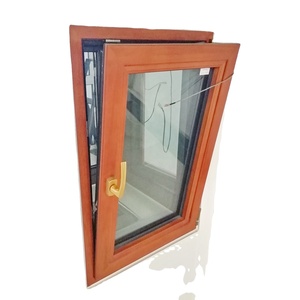
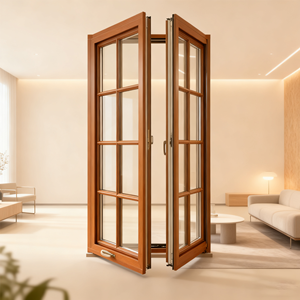
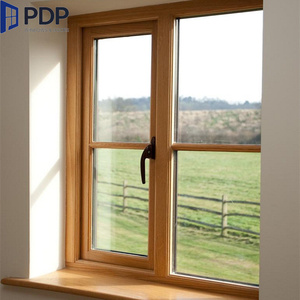
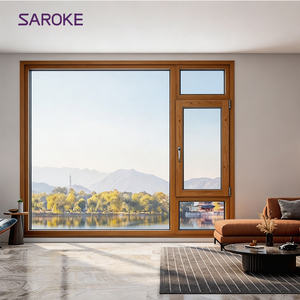
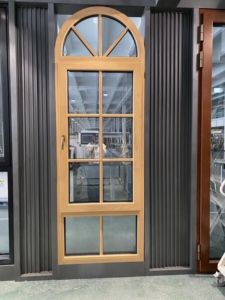
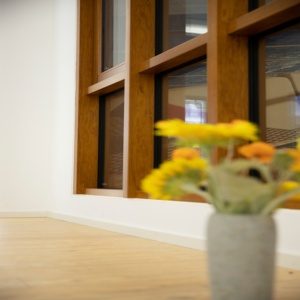
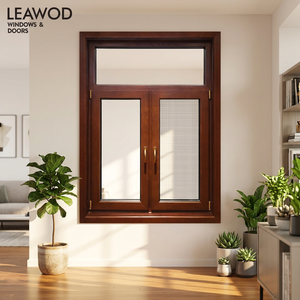
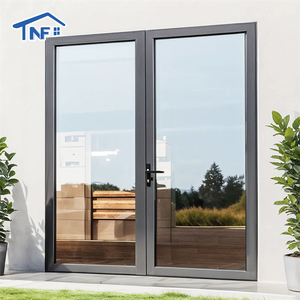
Why leading architects and general contractors source custom aluminum-clad timber fenestration from Foshan, China for Passive House and high-performance buildings.
Aluminum clad wood windows solve the traditional trade-off between warm interior aesthetics and rugged exterior weather resistance. By placing a heavy-duty extruded 6063-T5/T6 aluminum alloy profile on the exterior face and premium solid timber (such as Red Oak, Larch, Teak, or White Pine) on the interior, the window assembly achieves unparalleled mechanical stability.
The exterior aluminum jacket acts as an impervious barrier against severe precipitation, solar ultraviolet radiation, and wind-driven debris. Meanwhile, the interior solid timber frame provides a natural thermal break, eliminating cold bridges and delivering a luxurious architectural finish inside the residence.
Aluminum and wood possess significantly different coefficients of thermal expansion ($\alpha_{Al} \approx 23 \times 10^{-6} / K$ versus timber's negligible longitudinal thermal drift). Direct rigid attachment will lead to warping, sealant shear, or timber cracking over seasonal thermal cycles.
Our advanced manufacturing process employs high-strength nylon composite floating snap clips. These engineered clips secure the exterior aluminum shell to the interior wooden framework, allowing independent thermal movement while maintaining structural alignment and water-tight sealing under wind pressure exceeding 4.0 kPa.
Information Gain Insight: Standard aluminum window frames suffer from high thermal conductivity ($K \approx 160 \text{ W/m}\cdot\text{K}$), leading to thermal bridging. By combining 68mm-90mm solid timber frames ($K \approx 0.13 \text{ W/m}\cdot\text{K}$) with triple-pane Low-E insulated glass units, our overall window U-Factors drop to as low as 0.78 W/m²·K (0.14 BTU/h·ft²·°F), meeting stringent Passive House Institute (PHI) benchmarks.
| Performance Parameter | Standard Aluminum Clad Wood | Passive House Ultra-Thermal Series | Testing & Compliance Standards |
|---|---|---|---|
| Overall U-Factor (Uw) | 1.1 – 1.4 W/m²·K | 0.72 – 0.85 W/m²·K | NFRC 100 / EN ISO 10077-1 |
| Acoustic Rating (STC / Sound Insulation) | STC 38 – 42 dB | STC 45 – 48 dB (Triple Glazed) | ASTM E90 / ISO 140-3 |
| Wind Load Resistance | Class 5 (P3 ≥ 4.0 kPa) | Class 9 (P3 ≥ 5.5 kPa) | ASTM E330 / EN 12210 |
| Air Infiltration Rating | < 0.1 cfm/ft² @ 1.57 psf | < 0.03 cfm/ft² (A3 Level) | ASTM E283 / EN 12207 |
| Water Penetration Resistance | 700 Pa (15 psf) | 1050 Pa (22 psf) | ASTM E547 / EN 12208 |
| Wood Moisture Content Control | 8% – 12% Kiln Dried | 8% – 10% Laminated Finger-Jointed | DIN 68360 / ISO 13061 |
Key technological shifts shaping commercial and luxury residential window procurement across global markets from 2025 to 2030.
International building codes (such as California's Title 24, European EPBD directive, and Australia's NCC) are aggressively tightening carbon footprint limits. Wholesale buyers now prioritize suppliers capable of providing Environmental Product Declarations (EPD).
Sustainably harvested FSC-certified timber combined with low-carbon recycled aluminum extrusion profiles positions aluminum-clad wood windows as the premier choice for zero-carbon building certifications (LEED, BREEAM, and WELL).
Architectural demand is rapidly shifting toward minimal visual obstruction. Next-generation designs feature hidden sashes, floor-to-ceiling glass integration, and concealed German multipoint hardware (such as Roto Frank or Siegenia concealed hinges).
Simultaneously, smart home automation is driving demand for concealed motorized operators, electrochromic smart dynamic tint glass, and integrated rain-sensing automatic closure systems.
While triple-glazed units increase sash weight and profile depth, Vacuum Insulated Glass (VIG) delivers U-values under 0.60 W/m²·K in a profile thickness of just 8.3mm. Combining solid wood frames with VIG technology allows ultra-slim retrofitting in historic restoration projects and lightweight modern high-rises.
How global developers, importers, and contractors can optimize total landed cost while ensuring compliance with regional building standards.
One of the most critical failure points in low-tier imported wooden fenestration is improper wood drying, resulting in frame twisting, seal failure, or sash bind. Enterprise buyers must verify that the OEM factory operates computerized automated dry kilns and multi-stage vacuum pressure impregnation chambers.
Exterior aluminum clad profiles must withstand harsh atmospheric corrosion, especially in salt-spray coastal zones or industrial urban areas.
Based in Foshan, China—the global hub of architectural aluminum production—Doorreme delivers custom fenestration solutions engineered precisely to your project drawings.
Established in 2004, our family-founded company operates an expansive 123,000 m² manufacturing plant equipped with imported German and Italian CNC machining centers, automated cutting lines, and precision assembly workstations.
Over two decades of international trade experience supplying major commercial towers, luxury resorts, subway infrastructure, and multi-family developments across the Americas, Middle East, Australia, Southeast Asia, and Africa.
From structural wind pressure calculation and shop drawing submittals to pre-assembly structural silicone testing, every custom order undergoes multi-point quality verification before seaworthy packaging.
Send project elevation drawings or architectural schedule for preliminary engineering audit and feasibility review.
Select timber species, exterior powder coat/PVDF finishes, hardware brands (Roto/Siegenia), and glass build-ups.
Receive detailed 2D/3D shop drawings displaying section profiles, anchoring details, and opening dimensions.
Precision CNC milling, assembly, water spray testing, protective wooden crate packaging, and export shipment.
Expert answers regarding custom manufacturing, international certification compliance, shipping protection, and technical warranty terms.
 English