 English
Comprehensive Analysis: Selecting a Top China Aluminium And Glass Doors Supplier
In modern commercial and high-end residential architecture, fenestration systems are no longer passive exterior dividers; they are complex, highly engineered building envelopes. Selecting a premier China aluminium and glass doors supplier requires evaluating technical capabilities, metallurgical quality, thermal performance compliance, and supply chain transparency. As global energy codes tighten—such as Title 24 in California, the National Construction Code (NCC) in Australia, and the Energy Performance of Buildings Directive (EPBD) in Europe—procurement officers must move beyond superficial price-per-square-meter comparisons to analyze lifetime structural integrity and energy yields.
1. Metallurgical Excellence & Profile Engineering
The foundation of any high-performance aluminum window or door system lies in the raw alloy grade and extrusion profile design. Leading Chinese manufacturers like Doorreme exclusively utilize primary architectural-grade aluminum alloys, primarily 6063-T5 and 6061-T6.
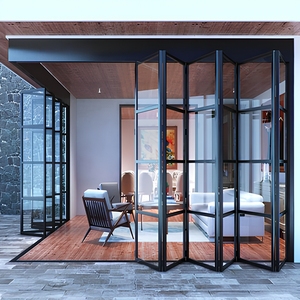
- Alloy 6063-T5: Offers an optimal balance of structural strength, surface finish smoothness, and corrosion resistance. It is the preferred choice for complex architectural extrusions, bi-fold door frames, and thermal break window profiles.
- Alloy 6061-T6: Provides significantly higher yield and tensile strength. It is deployed in structural mullions for unitized glass curtain walls, heavy-duty commercial entry doors, and high-span patio sliding door systems subjected to intense wind pressure.
Wall thickness is another critical variable. While residential-grade retail windows often utilize thin 1.2mm profiles, true structural architectural doors demand wall thicknesses ranging from 1.6mm to 3.0mm depending on frame height and structural load requirements. Extra-thick cross-sectional webbing ensures that heavy double-glazed or triple-glazed IGUs do not cause frame sag, track binding, or seal degradation over decades of continuous operation.
2. Thermal Break Mechanics & Energy Efficiency Trends
Uninsulated aluminum exhibits high thermal conductivity ($k \approx 200 \text{ W/m}\cdot\text{K}$), making un-broken frame profiles thermally inefficient in regions with extreme winter cold or summer heat. Top-tier Chinese suppliers integrate multi-cavity PA66-GF25 (Polyamide 66 reinforced with 25% glass fiber) thermal barrier strips.
By separating the exterior and interior aluminum extrusions with polyamide strips featuring a low thermal conductivity ($k \approx 0.3 \text{ W/m}\cdot\text{K}$), thermal bridging is virtually eliminated. When paired with high-performance double-glazed Insulated Glass Units (IGUs)—featuring magnetron sputtered Low-E coatings, warm-edge spacers, and 90%+ Argon gas fill—system U-factors drop dramatically from $U \ge 4.5 \text{ W/m}^2\cdot\text{K}$ down to $U \le 1.4 \text{ W/m}^2\cdot\text{K}$.
3. Advanced Glass Technologies & Structural Glazing
Glass accounts for 75% to 90% of a door or window unit's visible surface area. Consequently, a supplier's glass processing partnerships and inline quality control dictate the safety, acoustic, and thermal envelope performance.
- Toughened/Tempered Glass: Heat-treated glass delivering 4 to 5 times the flexural strength of standard annealed glass. Upon impact, it fractures into small, blunt cubic fragments to prevent injury.
- Laminated Safety Glass (PVB / SGP): Combines two or more glass sheets bonded under heat and pressure with a Polyvinyl Butyral (PVB) or SentryGlas® (SGP) interlayer. SGP interlayers provide 5 times the tear strength and 10 times the stiffness of standard PVB, making them mandatory for hurricane-impact doors, balustrades, and overhead glass roofs.
- Low-Emissivity (Low-E) Coatings: Spectrally selective microscopic metallic layers reflecting long-wave infrared heat while permitting maximum visible light transmittance (VLT). Double-silver and triple-silver Low-E options optimize Solar Heat Gain Coefficients (SHGC) for tropical or temperate zones.
Global Procurement Trends in Architectural Fenestration (2025–2030)
The global construction industry is undergoing rapid technological alignment. B2B buyers seeking factory direct partnerships in China are aligning with four dominant macro trends:
Trend A: Ultra-Minimalist Aesthetics & Concealed Frames
Architectural preferences have shifted decisively toward slim interlock sightlines (often as narrow as 18mm to 25mm) in large-format sliding doors. Concealed outer frames embedded directly into finished walls, floors, and ceilings create an uninterrupted visual flow. Achieving this requires exceptional profile rigidity and precision track alignment to prevent derailment.
Trend B: Smart Automation & Building Management System (BMS) Integration
Automated linear actuators, concealed multi-point motorized locking gear, and sensor-driven opening mechanisms are now standard requirements for luxury villas and commercial headquarters. Modern aluminum doors easily integrate with smart home protocols (Zigbee, Z-Wave, KNX) and rain/wind sensors for automated climate optimization.
Trend C: Strict Compliance with Local Storm & Hurricane Codes
Extreme weather events have prompted coastal regulatory bodies to mandate rigorous air infiltration, water penetration resistance, and structural cyclic load testing. Supplying markets such as Florida (Miami-Dade NOA standard), Australia (AS2047 / AS1288), and coastal East Asia requires certified impact-rated assembly lines.
Trend D: Carbon-Neutral Manufacturing & Recycled Aluminum Usage
With international focus on embodied carbon in buildings, developers are demanding environmental product declarations (EPDs). Re-melting recycled aluminum requires only 5% of the energy consumed in primary aluminum smelting. Chinese suppliers adopting green hydropower extrusion billets gain a distinct competitive advantage in international project bidding.